
Why AI agents are one of the hottest technology topics in 2026
Not long ago, most discussions about AI focused on chatbots that answered questions and generated content. In 2026, the conversation has shifted increasingly toward agents. The focus is no longer only on generating an answer, but on systems that can use tools, retrieve context, perform multi step tasks, and work with other systems.1
This shift matters because businesses do not want AI only for brainstorming or text generation. The expectation is much more practical. They want systems that can help with real work, such as analyzing documents, drafting responses, interacting with internal data, building workflows, and automating repetitive processes.2
From chatbot to agent
A standard chatbot responds to user input. An agent goes a step further. It can receive a goal, gather the required context, use tools, make decisions within defined boundaries, and return a result together with its process.1
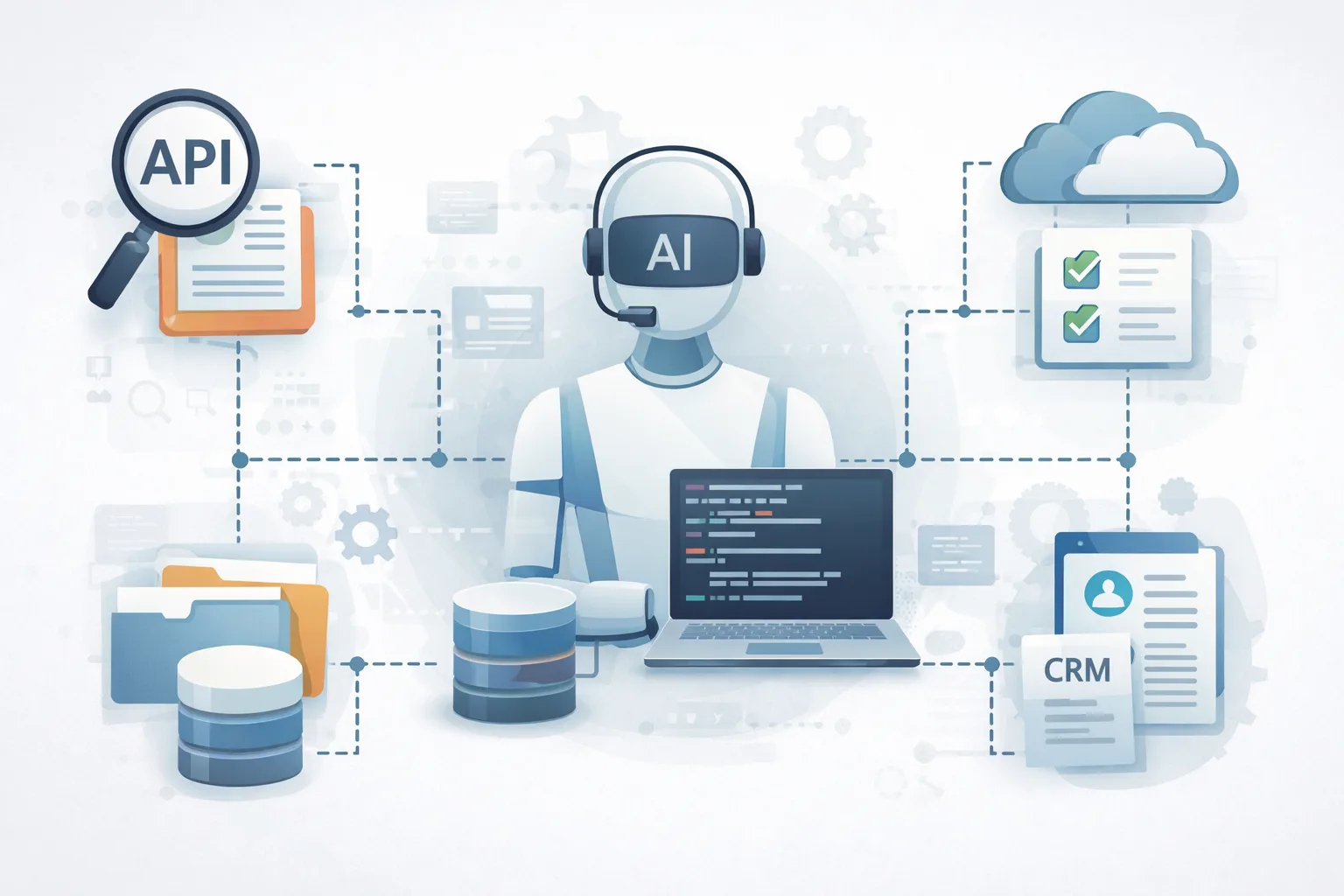
In practice, this means AI is no longer just a chat window. It becomes a work layer connected to files, databases, APIs, calendars, CRMs, and other business systems.3
Why now
One major reason is that the tooling around agents has matured quickly. OpenAI provides the Agents SDK and a visual Agent Builder. Google is investing in Agent Development Kit workflows and Vertex AI Agent Engine services. Microsoft has introduced its own Agent Framework along with guidance for governing, securing, and scaling agents across organizations.145
Another major reason is standardization. The Model Context Protocol, or MCP, was designed to help AI applications connect to external systems, tools, and data sources in a more consistent way. This is one of the reasons agents have become such a major topic. When integrations become easier, building real workflows becomes easier too.3
The real value comes from action, not conversation
The value of AI agents does not come only from sounding intelligent. The value appears when an agent can actually help complete work. For example, an agent can collect customer inquiries, search internal documentation, draft a first response, open a ticket if needed, and pass complex cases to a human.25
This also changes the role of software itself. Many interfaces are not going away, but a new layer is forming around them. The user no longer clicks through every step manually. More often, the user provides a goal and the system handles part of the execution.
Control is the most important issue
The more an agent can do, the more important control becomes. If an agent can access data, tools, and actions, a good model alone is no longer enough. You also need permissions, observability, audit trails, limits, and clear security rules.35
That is why governance has become such a central part of the discussion. The question is not only whether an agent works. The question is whether an organization can understand, monitor, and restrict what that agent is allowed to do.
Humans are not disappearing from the loop
One common misconception is that agents fully replace people. The reality is more cautious. Anthropic’s 2026 agentic coding trends report notes that many teams see AI as a strong collaborator, but the share of work that can be fully delegated remains limited, while supervision, validation, and human judgment still matter.2
That is why agents should not be seen as magical replacements. It is more realistic to see them as a new work layer that can create major productivity gains when designed well, but still requires strong architecture and clear boundaries.
Final thought
AI agents are one of the hottest technology topics in 2026 because they move AI from conversation into action. Development is moving toward systems that can use tools, interact with software, and complete multi step tasks inside real workflows.
The big opportunity lies in productivity and automation. The biggest challenge lies in control, security, and accountability.
In the next few years, the winners will probably not be the companies that simply add a chatbot to their website. The advantage will go to those that build well connected, secure, and genuinely useful agents.
- 1OpenAI Developers. Agents SDK, Agents, and Agent Builder. These explain how to build agentic applications, use tools, and assemble multi step workflows. Sources: Agents SDK, Agents, Agent Builder↩
- 2Anthropic. 2026 Agentic Coding Trends Report. The report explains how agentic AI is changing software development while emphasizing the continued importance of supervision, validation, and human judgment. Source: 2026 Agentic Coding Trends Report↩
- 3Model Context Protocol. What is MCP?, Specification, and Security Best Practices. These explain how MCP connects AI applications to external systems and what security considerations come with that model. Sources: What is MCP, Specification, Security Best Practices↩
- 4Google Cloud. Vertex AI Agent Engine overview and Google ADK learning materials. These show that dedicated platforms and tooling now exist for building and running agents in production. Sources: Vertex AI Agent Engine, Google ADK foundation codelab↩
- 5Microsoft Learn. Microsoft Agent Framework Overview and Cloud Adoption Framework for AI Agents. These cover building, managing, governing, and securing AI agents in organizations. Sources: Microsoft Agent Framework, AI agents adoption guidance↩